
Pinpointing how protein ‘peer pressure’ influences Parkinson’s disease
July 13, 2026

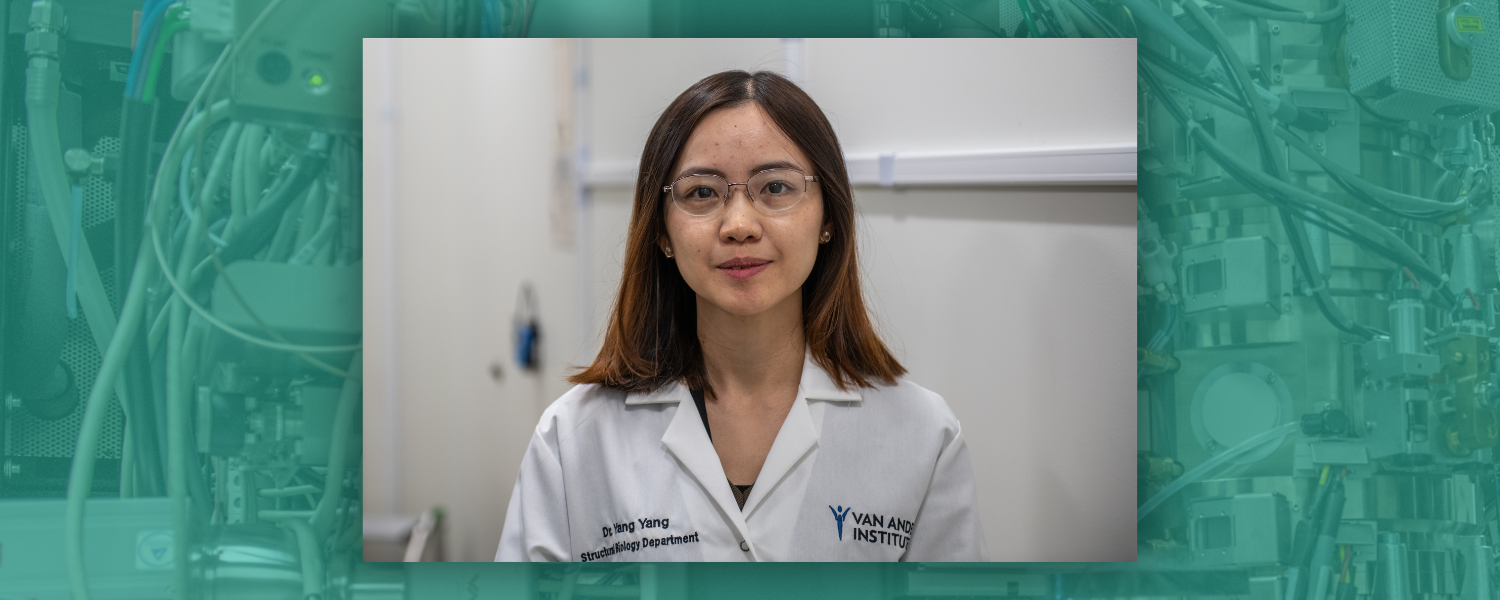
Most proteins in the brain follow the rules, maintaining precise shapes that help cells function normally.
But when proteins called alpha-synuclein go rogue and fold incorrectly, they can influence nearby alpha-synuclein to adopt the same harmful behavior. This protein-based peer pressure is called “seeding,” and studying it may help scientists better understand the root causes of Parkinson’s disease and other neurodegenerative disorders.

“In Parkinson’s, misfolded alpha-synuclein proteins stick together and form clumps called Lewy bodies, which damage the cells responsible for movement. As more of these cells die, symptoms like tremors and movement difficulties begin to appear,” said Van Andel Institute’s Dr. Yang Yang. “Understanding how and why seeding occurs can help us develop new ways to prevent it from happening.”
As a structural biologist with a focus on neurodegenerative diseases, Yang is uniquely positioned to explore how changes in alpha-synuclein’s shape enable it to clump and spread. This spring, she was named to two collaborative, multi-institutional teams of scientists who will use the latest technologies to identify the mechanisms that fuel seeding — and explore ways to prevent it.
“Two of the biggest questions in Parkinson’s disease are: what drives Parkinson’s and what causes alpha-synuclein to misfold? There are a lot of gaps that need to be filled in, and our work will help do just that,” Yang said. “These projects are great examples of how basic, mechanistic research can help make a big difference by giving us the tools and knowledge necessary to develop urgently needed therapies.”
Both teams were funded by Aligning Science Across Parkinson’s (ASAP) in partnership with The Michael J. Fox Foundation for Parkinson’s Research (MJFF) as part of a $261 million expansion of their Collaborative Research Network. With this new infusion of funding, ASAP and MJFF are supporting an additional 32 teams who will work to develop a blueprint of Parkinson’s and build a standard toolkit of research resources.
Learn more about Parkinson’s disease research at VAI ➔
Team Goedert, led by Dr. Michel Goedert at MRC Laboratory of Molecular Biology in the United Kingdom, will investigate how variations in misfolded alpha-synuclein can play roles in different types of neurodegenerative diseases, including Parkinson’s, dementia with Lewy bodies and multiple system atrophy. As a co-investigator on Team Goedert, Yang will harness VAI’s suite of high-powered cryo-electron microscopes and state-of-the-art Mass Spectrometry Core to explore the factors that influence the different ways alpha-synuclein misfolds, which is crucial to seeding.
Team West, led by Dr. Andrew West at Duke University, will focus on seed amplification assays, a powerful technique that detects tiny amounts of misfolded proteins by pushing them to replicate until they can be detected. In addition to having promise as a potential test for Parkinson’s, this assay could help the team distinguish between different types of misfolded proteins and identify subtype-specific antibodies, opening the door to development of personalized therapies. As part of her work with the team, Yang will use VAI’s new cryo-PFIB, a breakthrough sample preparation and microscopy platform that helps scientists study the inner workings of cells in unprecedented detail. The team’s research also will include samples from VAI’s Brain Bank, which houses brains donated by people from West Michigan with and without a neurodegenerative disease diagnosis.
To date, the Collaborative Research Network has funded 67 teams comprising nearly 400 lead investigators from over 180 institutions. Its team-based model emphasizes data sharing and coordination in pursuit of turning discoveries from bold ideas into precision diagnostics and therapies for Parkinson’s disease.
“I’m thrilled and honored to be part of the Collaborative Research Network as a member of Team Goedert and Team West,” Yang said. “By working together, we can do more than any single lab could do on its own. That means more data, more expertise and more opportunities to accelerate progress.”