

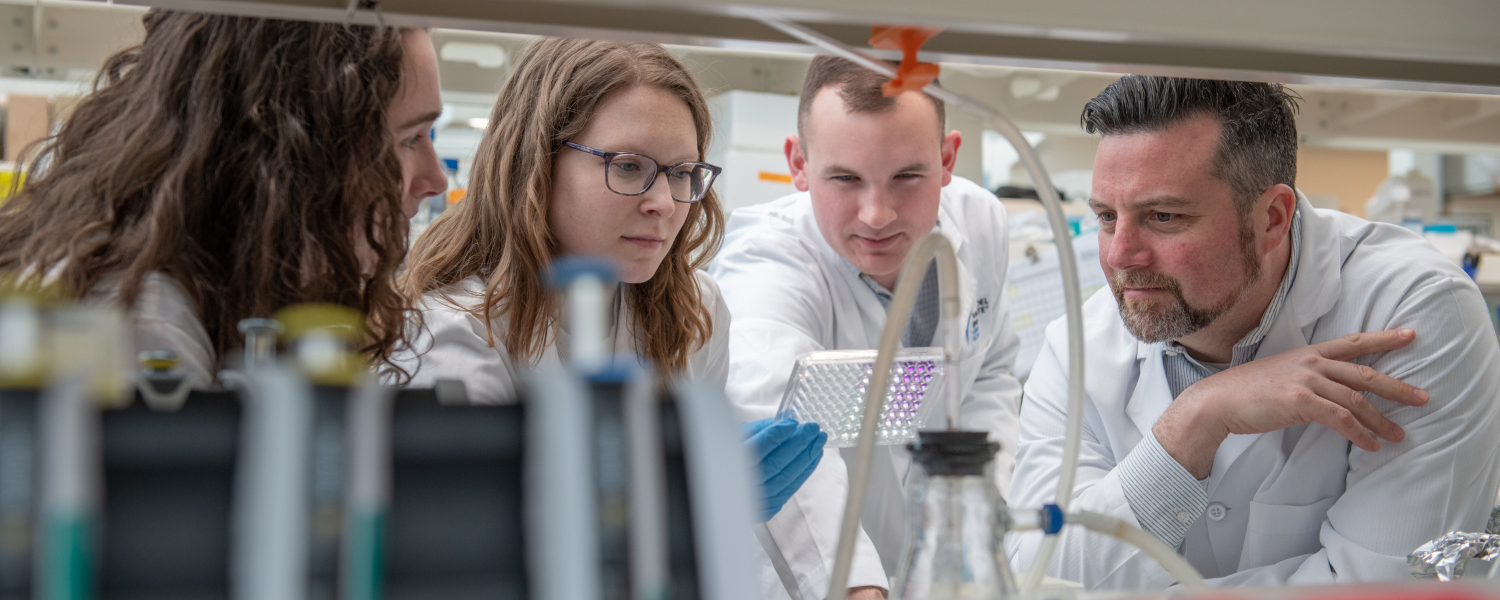
All cells rely on nutrients from the foods we eat to survive and thrive.
Thanks to research from VAI scientists and collaborators, we now know that cells don’t treat all nutrients the same: they use different nutrients for different purposes. These insights are important steps toward designing evidence-based diets to support the immune system and enhance cancer treatment, said VAI Professor Dr. Russell Jones.

“Using new technology, we’re able to precisely study how various nutrients impact cells. What we’re finding goes far beyond simply giving cells the energy to function,” Jones said. “Diet is a major part of health and understanding the fine details of how nutrients influence different cells — and processes within cells — opens a new world of opportunity to support cancer prevention and therapy.”
Take glucose, for example. Findings published in August by Jones and colleagues reveal that this specialized sugar does more than simply power T cells, the soldiers of the immune system: it helps cells facilitate their anti-cancer properties.1 Another study, published in December with VAI’s Dr. Evan Lien, found that metabolic by-products called ketones help immune cells become more effective tumor fighters by preventing cellular exhaustion.2
But there’s a hitch: cancer cells also rely on nutrients like glucose and ketones.
To satisfy their voracious appetites, cancer cells hijack the metabolic processes that transform nutrients into energy, siphoning resources to evade attack by the immune system.
Learn more about immunology research at VAI ➔
Another study by Lien published in September found that cancer cells also use ketones to fuel their growth.3 Likewise, glucose is a universal cellular fuel source, with both cancer cells and healthy cells using it in different ways.
Earlier research from Lien’s lab also revealed that limiting cancer cells’ access to certain fats makes them more susceptible to medications that cause ferroptosis, a type of cell death fueled by a buildup of iron in cells.4 But healthy cells use fats too — for energy, communication and supporting the protective membrane that surrounds each cell.
All of this raises an important question: If both immune cells and cancer cells use the same nutrients, albeit in different ways, how can we ensure only immune and other healthy cells benefit?
“Because metabolism affects everything in the body, it is difficult to draw straight lines from point A to point B,” Jones explained. “That said, worthwhile things are rarely simple. We know that there isn’t a one-size-fits-all approach. Our findings are giving us a much clearer picture of all the interconnected pieces that link nutrition to health and disease, which will allow us to design adaptable, targeted approaches.”
Taken together, these discoveries underscore the importance of studying metabolism in the context of the immune system and cancer. The Jones Lab and Lien Lab are already hard at work building on their discoveries and searching for ways to supercharge immune cells while making cancer cells more vulnerable to immune attack.
“Metabolism quite literally fuels health and disease,” Lien said. “The more we understand, the better we can use that knowledge to improve cancer outcomes.”
Learn more about metabolism and nutrition research at VAI ➔
Funding Acknowledgements
Research reported in this publication was supported by:
1 The National Institute of Allergy and Infectious Diseases of the National Institutes of Health under award no. R01AI165722 (Jones).
2 Van Andel Institute’s Metabolism and Nutrition (MeNu) Program; the National Cancer Institute of the National Institutes of Health under award no. U01CA297713 (Jones); and the National Institute of Allergy and Infectious Diseases of the National Institutes of Health under award no. R01AI165722 (Jones).
3 The National Cancer Institute of the National Institutes of Health under award nos. R00CA255928 (Lien) and T32CA251066 (House; PI: Peter A. Jones); the National Institute of Allergy and Infectious Diseases of the National Institutes of Health under award no. R01AI165722 (Jones); Van Andel Institute’s Metabolism and Nutrition (MeNu) Program (Lien); VAI MeNu Program Pathway to Independence Awards (Jeong and Longo); and a Canadian Institutes of Health Research Fellowship under award no. MFE-181903 (Longo).
4 The National Cancer Institute of the National Institutes of Health under award no. R00CA255928 (Lien) and T32CA251066 (P. Jones); and Van Andel Institute’s Metabolism & Nutrition (MeNu) Program.
The content is solely the responsibility of the authors and does not necessarily represent the official views of the National Institutes of Health or other funding organizations.