
For Legionella bacteria, taking over a cell means playing by its rules
August 26, 2026
GRAND RAPIDS, Mich. (Aug. 26, 2026) — When it comes to invading healthy cells, Legionella bacteria rely on blending in rather than breaking in.
New research from Van Andel Institute scientists demonstrates how a protein produced by Legionella mimics the behavior of the host cell’s own proteins. This clever ruse allows the protein, RomA, to change how the host’s genes are regulated and create conditions that help the bacteria survive and multiply.
But there is a limit to RomA’s effectiveness. Although the protein can read and respond to the host’s existing epigenetic landscape, those same signals constrain what RomA can and cannot do.
The result is a remarkable biological trade-off: By taking its cues from the host cell, Legionella can exploit its epigenetic machinery but also becomes subject to the host’s rules.

“What makes these findings so exciting is that they reveal a two-way conversation between host and pathogen that we didn’t fully appreciate before,” said Evan Worden, Ph.D., an assistant professor in VAI’s Department of Structural Biology and corresponding author of the study. “We knew bacteria like Legionella can manipulate host cells’ physiology, but we didn’t know that cells’ existing epigenetic landscape puts guardrails around what the pathogen can do. Understanding this nuanced interaction gives us a better picture of how these infections work and offers new avenues for developing improved therapies.”
Legionella is best known for its role in Legionnaire’s disease, a severe type of pneumonia caused by inhaling water droplets containing the bacteria. Once in the lungs, Legionella burrows into immune cells called macrophages, turning them into refuges that help the bacteria survive and multiply. Their ability to live inside host cells makes Legionella and other intracellular pathogens difficult to treat.
The study, published in the Proceedings of the National Academy of Sciences, provides the first evidence that bacterial effector proteins like RomA can be influenced by the host’s existing epigenetic landscape. Epigenetics control which genes are “on” or “off” without altering the underlying DNA sequence. To do this, epigenetics relies on chemical tags to govern how DNA is packaged and accessed.
What makes RomA’s behavior particularly striking, Worden said, is that bacteria and human cells organize and regulate their DNA in fundamentally different ways. Human DNA is precisely packaged within a cell’s nucleus, where it wraps around spool-like histone proteins to form a structure called chromatin. Bacteria lack a nucleus and a chromatin-based organizational system.
Learn more about structural biology research at VAI ➔
“It blew our minds that RomA — a bacterial protein — can operate within and respond to a chromatin-based system that bacteria themselves do not have,” Worden said. “Over time, pathogens like Legionella and host cells like macrophages may have found ways to borrow from and respond to each other’s biology. Our findings give us a fascinating look into how deeply intertwined these relationships might be.”
The implications of the findings may extend far beyond Legionella. Other intracellular pathogens, including tuberculosis-causing Mycobacterium tuberculosis, deploy effector proteins that, like RomA, manipulate the internal environment of the cells they infect.
Going forward, Worden and his collaborators hope to identify other Legionella proteins that read and respond to their host’s epigenetics. Their candidate pool is vast: Legionella produces at least 370 effector proteins, many of which have no known function. Identifying other proteins that influence host epigenetics — and determining if they too are subject to the host’s epigenetic rules — could clarify whether RomA is relatively unique or if it reflects a broader strategy used by bacteria to manipulate host cells.
Other authors include Shantinique S. Miller, Joel A. Hrit, Ph.D., and Scott B. Rothbart, Ph.D., of Van Andel Institute. VAI’s Cryo-EM Core (RRID:SCR_023210) assisted with data collection.
Research reported in this publication was supported by the National Institute of General Medical Sciences of the National Institutes of Health under award no. R35GM152184 (Rothbart) and the National Institute of Allergy and Infectious Diseases of the National Institutes of Health under award no. R21AI173758 (Worden). The content is solely the responsibility of the authors and does not necessarily represent the official views of the National Institutes of Health.
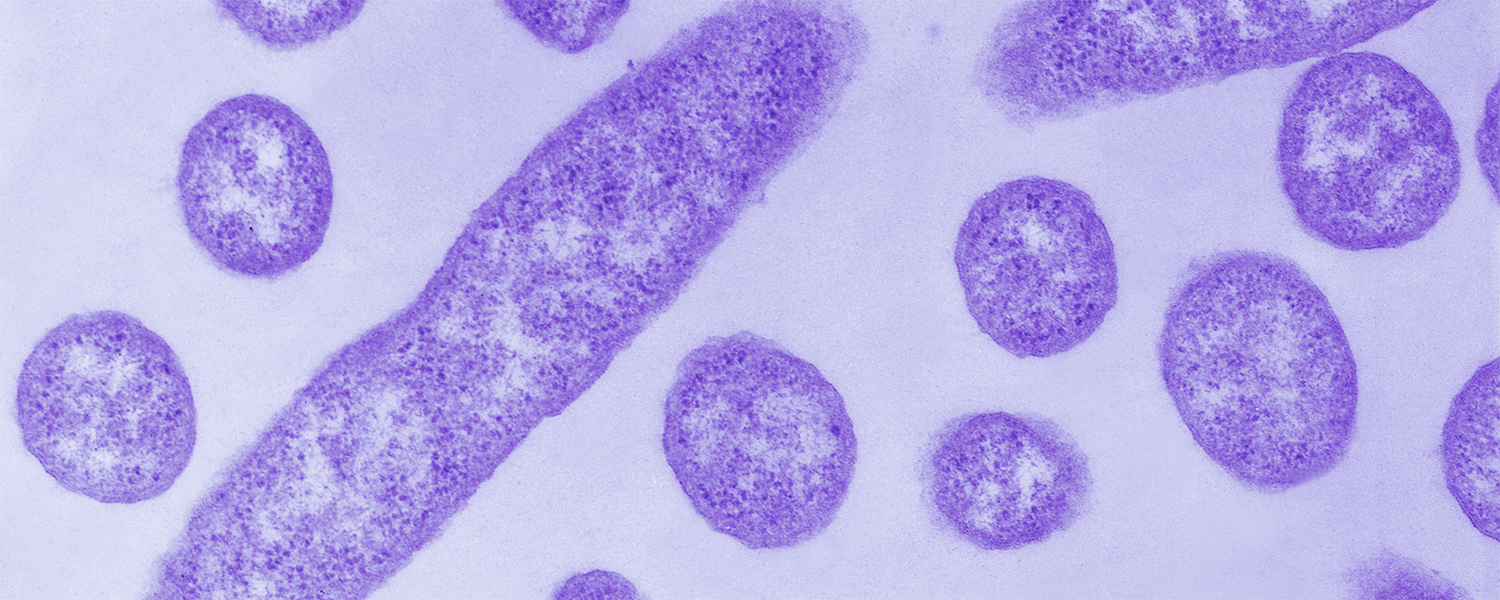
Image attribution and caption: This transmission electron micrograph (TEM) depicts multiple Legionnaires’ disease bacteria cultivated on bacteriologic medium. The image highlights aspects of the ultrastructural morphology of the bacterium, Legionella pneumophila. Image courtesy of CDC/Martin D. Hicklin, M.D.