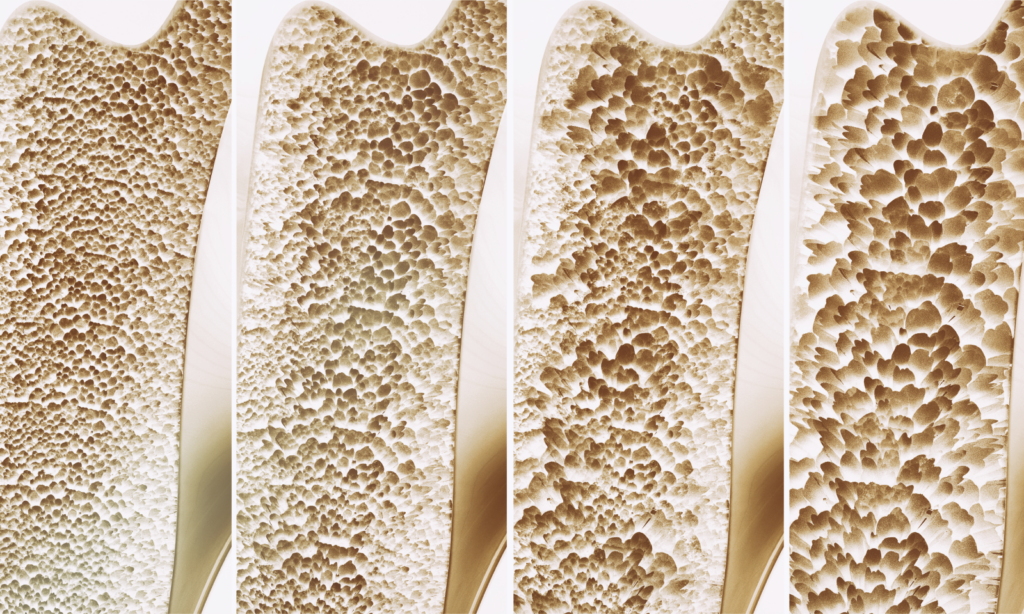
There are many types of bone diseases, including cancers that start in or spread to the skeleton, and degenerative diseases such as osteoarthritis and osteoporosis. By studying how bone develops, how cells communicate, and how cells respond to the environment and change with age, VAI scientists are working toward new breakthroughs that may fuel improved diagnostic and treatment strategies.
VAI scientists study:
Osteoarthritis: A degenerative joint disease caused by the breakdown of cartilage, a shock-absorber-like tissue between the bones.
Osteoporosis: A disease that causes the bones to become porous and weak, and can lead to painful breaks that may be caused by something as simple as a sneeze or gentle bump.
Sarcomas: A group of cancers that start in the bones or in the connective tissues around the bones.
Dr. Steensma received his B.A. from Hope College in Holland, Mich., and his M.D. from Wayne State University School of Medicine in Detroit, Mich. He subsequently completed internship and residency training in the Grand Rapids Orthopaedic Surgery Residency Program. After completing residency, he trained in the laboratories of Drs. George Vande Woude and Rick Hay at VAI under an Orthopaedic Research and Education Foundation training award. Subsequently, Dr. Steensma was admitted into the prestigious fellowship program in Musculoskeletal Surgical Oncology in the Department of Surgery at Memorial Sloan Kettering Cancer Center in New York where he obtained sub-specialty training in the surgical management of musculoskeletal tumors. His fellowship in New York also provided Dr. Steensma with the opportunity to work in the laboratory of Dr. Steve Goldring, Chief Scientific Officer of the Hospital for Special Surgery (HSS) in New York. Dr. Goldring is one of the world’s leading orthopaedic researchers and has a particularly strong reputation for training leading clinician-scientists. During his training with Dr. Goldring, Dr. Steensma further developed his interests in understanding the molecular and cellular mechanisms underlying the development of bone and soft-tissue sarcomas. Dr. Steensma joined Van Andel Institute in 2010 as an Associate Scientific Investigator in the Center for Skeletal Disease Research. In 2014, he was named as one of the winners of the inaugural Francis S. Collins Scholars Program in Neurofibromatosis Clinical and Translational Research.
Bart Williams, Ph.D.
Director, Core Technologies and Services; Professor, Department of Cell Biology
Dr. Williams received his Ph.D. in biology from Massachusetts Institute of Technology in 1996, where he trained with Tyler Jacks. For three years, he was a postdoctoral fellow at the National Institutes of Health in the laboratory of Harold Varmus, former Director of NIH. Dr. Williams joined VAI as a scientific investigator in July 1999. He was promoted to professor in 2013 and served as chair of VAI’s Department of Cell Biology from 2010 to 2022. In 2022, he was appointed director of VAI’s Core Technologies and Services, which provides leading-edge shared scientific resources to bolster research at the Institute and beyond.
Dr. Yang received his B.S. in biochemistry from Wuhan University, and his Ph.D. in biochemistry from the Shanghai Institute of Biochemistry and Cell Biology, Chinese Academy of Sciences (SIBCB, CAS). He then joined Baylor College of Medicine as a postdoctoral fellow working with Drs. Paul Overbeek and Brendan Lee. In 2009, he began serving as an instructor in the Department of Molecular and Human Genetics at Baylor. Dr. Yang joined VAI as an assistant professor in February 2013.