
Can a chronic stomach infection influence Parkinson’s disease risk?
February 27, 2026

Most cases of Parkinson’s disease cannot be attributed to one distinct cause.
Parkinson’s is a progressive disorder characterized by the loss of specialized nerve cells that help regulate movement, the brain’s reward system and cognition.
Although the disease is classically defined by its movement-related symptoms — such as tremor, stiffness and slowness — non-movement-related symptoms can start years or even decades before diagnosis. These early signs may include constipation, loss of sense of smell, pain, cognitive impairment and trouble sleeping.
The disease’s complexity makes it extremely challenging to pinpoint when and why Parkinson’s begins. Scientists have discovered dozens of gene mutations linked to Parkinson’s, but genetics alone only account for fewer than 10% of cases. Most cases likely result from a mix of factors, including genetics, epigenetics and environmental exposures.
This uncertainty has pushed scientists to look beyond the brain toward other influences that may affect disease risk over time.
“There is growing evidence that a substantial amount of Parkinson’s risk comes from our environment,” said Dr. Michael Henderson, an associate professor in VAI’s Department of Neurodegenerative Science. “Our goal is to leverage what we know about environmental risk factors to understand the mechanisms that drive disease development and progression.”
One area of interest is the role that infections might play. Previous research has linked certain infections with Parkinson’s although the exact mechanisms behind this association aren’t well understood.
An example is Helicobacter pylori, a bacterium that causes stomach infections and ulcers that can lead to stomach cancer. H. pylori is most prevalent in regions with poor sanitation and contaminated food and water. If left untreated, H. pylori can spark inflammation that damages the lining of the stomach and small intestine.1
Now, recent findings by Henderson and colleagues reveal how H. pylori infection may influence the risk and progression of Parkinson’s.
Learn more about research in the lab of Dr. Michael Henderson ➔
The study, published in the Journal of Neuroinflammation, suggests that chronic H. pylori infection triggers an immune response in the gut that can lead to brain inflammation and loss of specialized nerve cells.
“We know that chronic infections can increase the likelihood of developing Parkinson’s,” Henderson said. “Our study aimed to test several different avenues by which an infection in the gut could change the brain.”
When H. pylori infection occurs, the immune system kicks in, triggering an inflammatory response. Although inflammation is a normal part of the immune response, prolonged inflammation can have damaging effects on the rest of the body, including the brain.
Importantly, Henderson and his team found that H. pylori-related risk occurs independent of all other known risk pathways associated with the disease and can be limited by treating the infection itself.
The study was done in lab models, but similar signs of immune cell activity have been observed in brains of people with Parkinson’s. As evidence grows that immune reactions in the brain may be triggered by infections elsewhere in the body, Henderson and his team hope to better understand which infections are involved and how they influence brain health.
“Our findings reinforce the role that our immune system plays in age-related neurodegeneration,” Henderson said. “This opens a new avenue for understanding Parkinson’s as a multi-system disorder and brings us one step closer to developing more effective treatments for Parkinson disease.”
Learn more about Parkinson’s disease research at VAI ➔
Funding Acknowledgements
Research reported in this publication was supported by The Farmer Family Foundation (Henderson, Brundin, Pospisilik), Van Andel Institute and a Van Andel Institute Inspire Fellowship (Soto-Avellaneda). The content is solely the responsibility of the authors and does not necessarily represent the official views of the funding organizations.
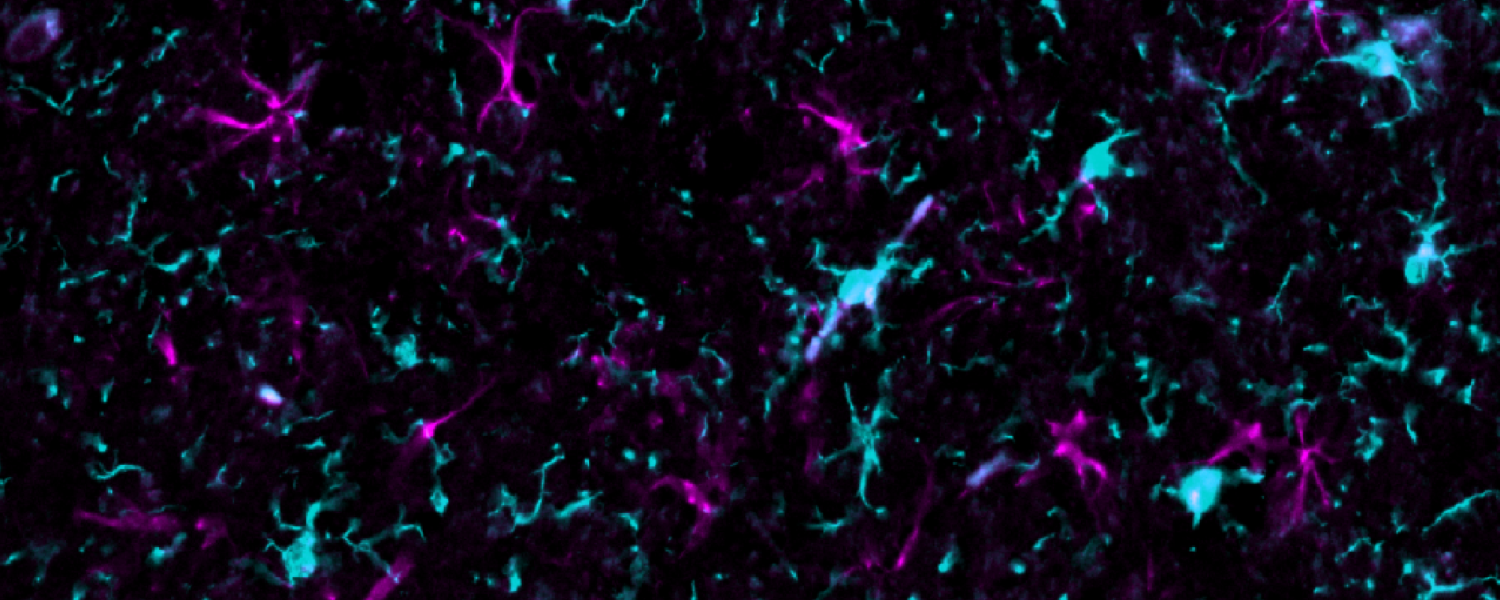
Image Caption: A new study by Van Andel Institute scientists reveals how Helicobacter pylori infection triggers an immune response in the gut that can lead to chronic brain inflammation. This inflammation may contribute to Parkinson’s disease risk. The image depicts immune and support cells (in blue and magenta) following treatment for H. pylori infection.
Sources
1Cleveland Clinic. (2025 May 5). H. pylori infection. https://my.clevelandclinic.org/health/diseases/21463-h-pylori-infection